Why Exporting Unlicensed Controlled Medicines from the UK is so difficult
Exporting unlicensed controlled medicines from the UK involves overlapping MHRA, Home Office and overseas rules with no clear single pathway.

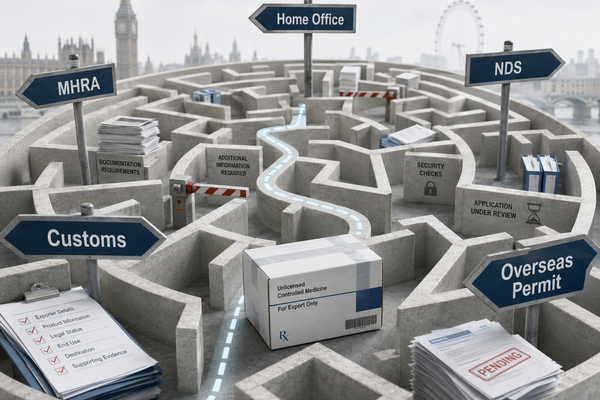
The rules are spread across several government departments. The terminology is technical, the required permissions depend on the product and destination, and there is no single official pathway explaining what must happen, in what order, or which licence applies.
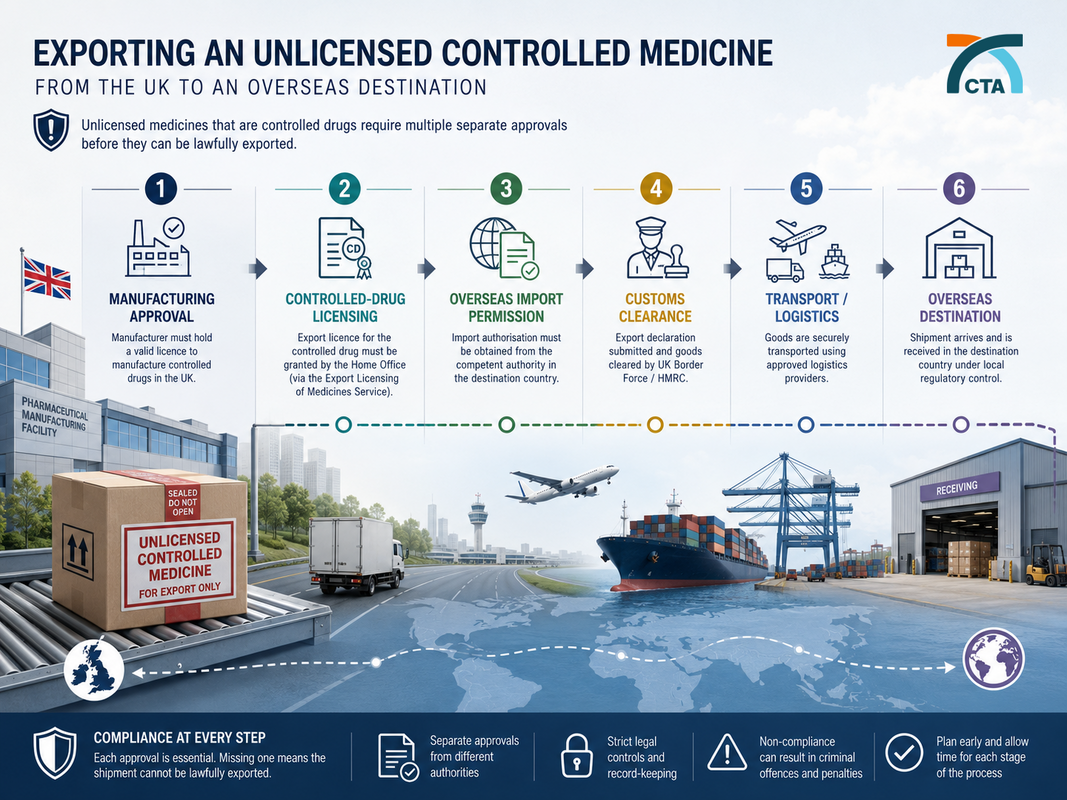
The CTA’s internal findings (report below) shows that exporting an unlicensed medicine that is also a controlled drug involves several overlapping regulatory processes.
A business may need approval from the Medicines and Healthcare products Regulatory Agency, known as the MHRA, authority from the Home Office, permission from the importing country, and the correct customs and transport arrangements.
Holding one approval does not mean that the other requirements have been satisfied
“Unlicensed medicine” and “controlled drug” describe two different regulatory characteristics.
An unlicensed medicine is a medicinal product without a UK marketing authorisation. It may still be manufactured or supplied in limited circumstances, including where a patient has a special clinical need that cannot be met by a licensed medicine.
A controlled drug is a substance subject to additional restrictions under UK drugs legislation. Many cannabis-based medicines fall within this category.
A cannabis-based unlicensed medicine may therefore be regulated both as a medicine and as a controlled substance.
The MHRA deals with the medicines framework, including manufacturing, wholesale distribution and pharmaceutical quality requirements. The Home Office deals with controlled-drug licensing. The importing country applies its own domestic rules, while customs, security and transport obligations sit alongside them.
The difficulty is not necessarily that there is no regulation. The difficulty is that the different requirements are not presented as one connected export process.
To export a controlled drug, a business must usually hold an appropriate Home Office domestic controlled-drug licence and have access to the National Drugs Control System, known as NDS.
The overseas customer and the exact product will normally need to be registered within NDS. The exporter must obtain the importing country’s controlled-drug import permit before submitting a Home Office export licence application for the shipment.
Home Office export licences are generally shipment-specific and time-limited. Delays involving overseas permits, product registration, customs paperwork or transport arrangements can therefore cause licences and documents to fall out of alignment.
Most importantly, a Home Office export licence authorises the international movement of the controlled drug. It does not demonstrate that the company has the correct medicines authorisation to manufacture, hold, sell, distribute or export the product.
This distinction is essential. A company could satisfy the controlled-drug export process while still lacking the correct MHRA licence for the underlying medicines activity.
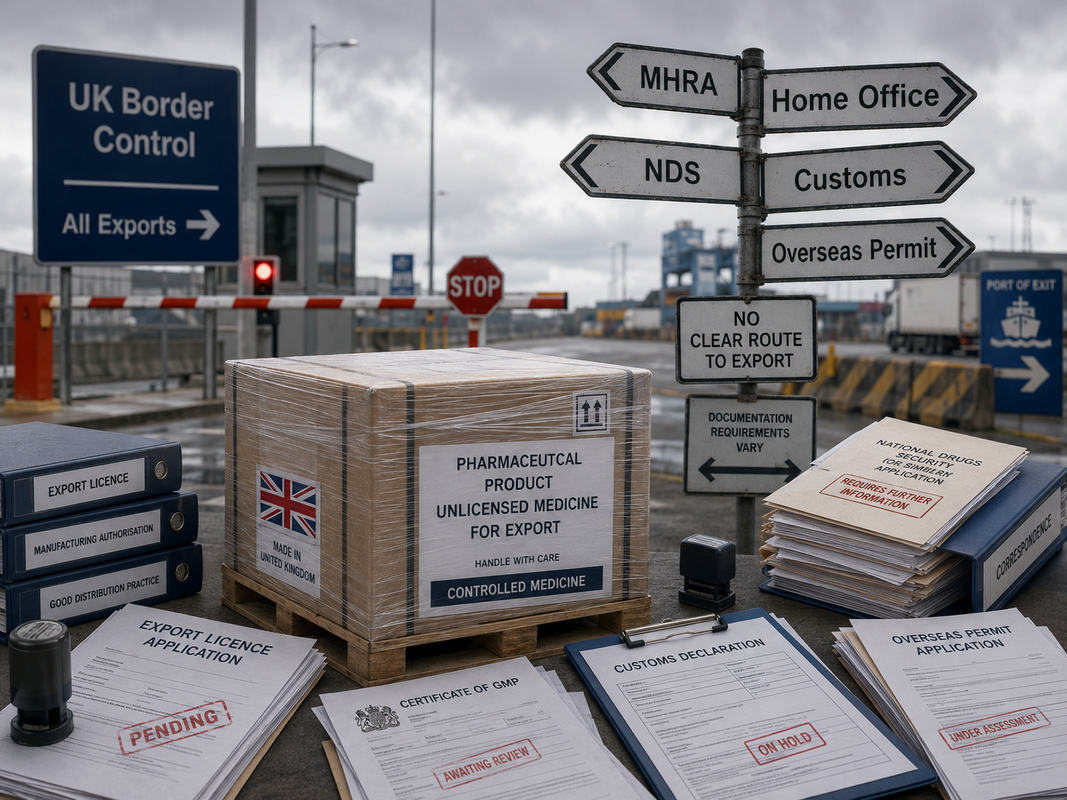
One of the most significant issues identified by the CTA is that the correct MHRA route may depend on where the medicine is being sent.
For certain exports to countries within the European Economic Area, an unlicensed medicine may remain within the UK “specials” framework. This may involve a Manufacturer’s “Specials” Licence, commonly shortened to MSL, together with any wholesale authorisation required for the particular supply arrangement.
However, current MHRA guidance indicates that an unlicensed medicine manufactured for export to a country outside the relevant approved-country framework is not treated as a “special” in the same way.
An ordinary manufacturer’s licence may instead be required, together with a Qualified Person who is responsible for certifying and releasing each batch.
This is not a minor administrative distinction.
A business operating under an MSL may have designed its quality system, staffing and manufacturing arrangements around the supply of specials. Moving to an ordinary manufacturing authorisation can involve different permissions, Qualified Person oversight, batch certification and wider Good Manufacturing Practice requirements.
For occasional or low-volume exports, the cost and complexity of meeting those requirements may make a commercial opportunity unrealistic.
It also creates a risk that a company could enter into an overseas supply agreement before discovering that its existing UK authorisations do not cover the proposed activity.
The pathway becomes even less clear where a medicine is imported into the UK and later exported to another country.
The correct route may depend on several factors:
There is also a separate regulatory concept known as an “introduced medicinal product”. This may apply in certain circumstances where an unlicensed medicine is brought into the UK and subsequently exported.
However, current public guidance does not clearly explain how the introduced medicinal product framework interacts with controlled-drug requirements, cannabis-based medicines or products previously imported as specials.
Members therefore need clarification covering both UK-manufactured products and imported stock intended for re-export.
Some destination countries may request a Certificate of a Pharmaceutical Product or another certificate issued by the MHRA.
These certificates can support an overseas registration or import process, but they are not the substantive permission to export the medicine.
They do not replace:
Businesses should therefore avoid treating an MHRA export certificate as confirmation that the full export pathway has been approved.
The Export Control Joint Unit, known as ECJU, mainly deals with strategic export controls. These can include military and dual-use goods, sanctions and certain tightly controlled products.
ECJU is not normally the principal licensing route for an ordinary export of an unlicensed cannabis-based medicine.
It may nevertheless become relevant where the destination is subject to sanctions or where another strategic export-control category applies.
The CTA’s investigation concludes that members need a single, joined-up pathway from government.
This should include a joint MHRA and Home Office decision tree covering:
The guidance should clearly explain when an MSL is sufficient, when an ordinary manufacturer’s licence is required, when a wholesale authorisation is needed, and when a Qualified Person must certify and release the batch.
Members would also benefit from one practical checklist showing the correct sequence for obtaining the destination-country import permit, completing NDS registration, applying for the Home Office export licence, obtaining any MHRA certificates, completing customs requirements and arranging compliant transport.
Until clearer guidance is published, businesses should not treat a Home Office controlled-drug export licence as confirmation that the entire export is authorised.
Before committing stock, accepting purchase orders or signing supply agreements, exporters should map the complete pathway.
This should include confirming:
The practical message is simple: the export must be assessed as one connected regulatory chain, even though government currently presents the requirements through separate departments and systems.
The CTA will continue to seek clearer, coordinated guidance so that lawful businesses can protect patients, make informed investment decisions and develop compliant international trade.