Medical Cannabis UK: 10 Key Questions Answered
Is medical cannabis legal in the UK? Learn about prescriptions, eligibility, NHS access, costs, driving, employment, travel and patient rights


This guide answers ten of the most frequently asked questions about medical cannabis in the UK, including NHS access, private prescriptions, costs, driving, employment, travelling abroad and patient rights.

The change in the law created a legal route for certain cannabis-based products for medicinal use to be prescribed by doctors on the General Medical Council Specialist Register.
Medical cannabis remains a controlled drug. It is only lawful when it has been prescribed to the patient through the appropriate medical route and is possessed and used in accordance with that prescription.
The legalisation of medical cannabis did not legalise recreational cannabis. Cannabis obtained without a valid prescription may still be illegal, regardless of whether someone believes they are using it to manage a medical condition. (GOV.UK)
Patients should keep their medicine in its original dispensing container, with the pharmacy label intact. It is also sensible to retain access to a copy of the prescription or a letter from the prescribing clinic.

A GP cannot normally initiate an unlicensed medical cannabis prescription independently. However, a GP may provide medical records, summary of care, discuss existing treatments, or refer a patient to an appropriate specialist.
Patients seeking private treatment will usually need to:
A consultation does not guarantee that medical cannabis will be prescribed, however the consultant will look at the patient holistically. The decision must be made for the individual patient and remain within the prescriber’s professional competence.
NHS England states that both NHS and private prescribing of unlicensed cannabis-based products must be undertaken by, or under the direction of, an appropriately registered specialist doctor. (NHS England)
Patients should check that a clinic is registered with the appropriate healthcare regulator and that the doctor responsible for prescribing appears on the GMC Specialist Register.

A specialist may consider prescribing where there is an unmet clinical need and where the potential benefits are judged to outweigh the risks for that particular patient.
The decision may take account of:
NICE guidance considers cannabis-based medicinal products in relation to intractable nausea and vomiting, chronic pain, multiple sclerosis-related spasticity and severe treatment-resistant epilepsy. However, NICE does not recommend every cannabis medicine for every condition covered by the guideline. (Nice)
The existence of a condition does not create an automatic entitlement to treatment. Prescribing remains a case-by-case clinical decision. (GOV.UK)

The NHS states that cannabis-based medicines are likely to be prescribed only to a small number of patients. NHS prescribing is generally considered in limited circumstances, including:
A specialist will normally consider other established treatment options before deciding whether a cannabis-based medicine is appropriate. (nhs.uk)
Some cannabis-based medicines have a UK marketing authorisation for specific indications. Many other products prescribed through private clinics are unlicensed medicines, sometimes referred to as “specials”.
An unlicensed medicine is not necessarily an unlawful or substandard medicine. It means that the product does not hold a UK marketing authorisation for the particular product and use. The specialist takes additional professional responsibility when deciding to prescribe it.
NHS England explains that the limited evidence base and unlicensed status of many cannabis-based products continue to influence NHS prescribing. (NHS England)
A private prescription will not normally be transferred automatically to an NHS GP. NHS England states that shared care should not generally be taken on for treatment that has not been commissioned by the NHS, unless exceptional arrangements have been agreed.

The total cost depends on the clinic, the prescribed product, dosage, appointment frequency and whether additional administrative or delivery charges apply.
A patient may need to pay separately for:
Some clinics offer membership plans or reduced fees for certain patients, but the lowest advertised consultation price does not necessarily represent the full monthly cost of treatment.
Before registering, patients should ask the clinic for a written explanation of all likely charges. They should establish whether the medicine, follow-up appointments, repeat prescriptions and delivery are included.
Private prescribing is legally possible, but it operates separately from routine NHS commissioning. This means prices and payment structures can vary between providers. (NHS England)
Patients should not purchase products from an unregulated online seller merely because the seller describes them as “medical cannabis”. A genuine prescription medicine must pass through the appropriate prescribing and pharmacy supply route.

Prescription medical cannabis may contain cannabidiol, known as CBD, tetrahydrocannabinol, known as THC, or different combinations of cannabinoids.
THC is the cannabinoid most closely associated with intoxication, although its effects vary according to the dose, product, route of administration and individual patient. CBD does not produce the same intoxicating effects as THC, but it can still cause side effects and interact with other medicines.
A CBD oil sold as a food supplement is not equivalent to a prescribed cannabis-based medicine. Consumer CBD products cannot legally be marketed as treating or preventing a medical condition unless they have the appropriate medicines authorisation.
The NHS warns that products bought online may have uncertain content or quality and may be illegal or potentially unsafe. It also distinguishes consumer CBD products from cannabis-based medicines prescribed by a specialist. (nhs.uk)
The legal position of a CBD product depends on its composition, presentation, intended use and whether it contains controlled cannabinoids. The Home Office advises businesses handling cannabis-derived products to ensure that their products and activities comply with controlled-drug legislation. (GOV.UK)
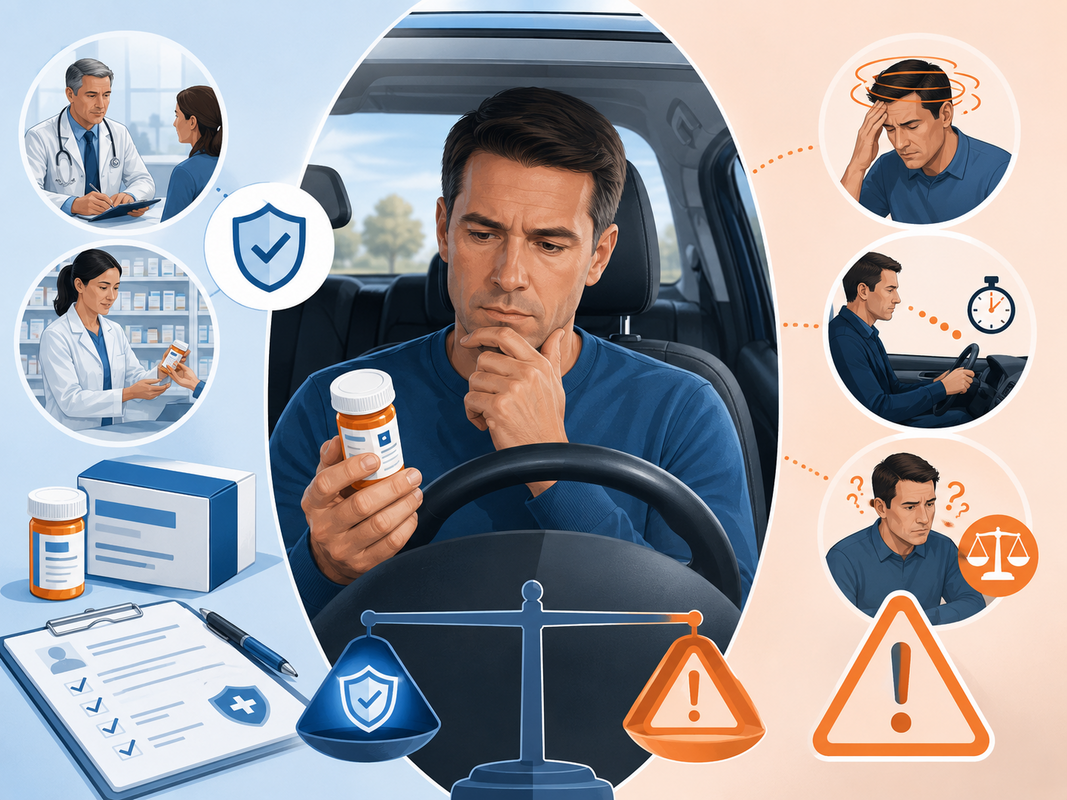
THC is included within UK drug-driving legislation. A person may commit an offence if they drive while unfit because of a drug or if they exceed a specified drug limit without a valid medical reason.
The law provides a potential statutory medical defence for someone who:
This is a legal defence, not automatic permission to drive and not an exemption from being stopped, tested or investigated. (GOV.UK)
Patients should not drive if they feel sleepy, dizzy, confused, slowed down, unable to concentrate or otherwise impaired. Extra caution may be required when treatment begins, when the dose changes or when another medicine is added.
Government guidance says that people taking prescription medicines may find it helpful to carry evidence of the prescription in case they are stopped by the police. (GOV.UK)
A membership card, patient card or photograph of a product is not a substitute for a valid prescription and properly labelled medicine.
Driving law is not identical throughout every part of the UK. Patients should obtain advice relevant to where they live and drive.
An employer may have legitimate concerns where work involves driving, operating machinery, handling hazardous materials, caring for vulnerable people or performing another safety-critical activity.
However, an employer should not simply assume that a person is incapable of working because they have been prescribed medical cannabis. Any concerns should be considered individually, based on evidence and an appropriate risk assessment.
The Equality Act 2010 may protect a person where their underlying physical or mental health condition has a substantial and long-term negative effect on normal daily activities. The legal protection normally arises from the disability or health condition, not from the prescription itself. (GOV.UK)
Where the Equality Act applies, an employer may have a duty to consider reasonable adjustments. These could include changes to working hours, break arrangements, duties or the way medication is stored and administered. Employers do not have to make adjustments that are unreasonable or that leave an unmanageable safety risk. (Acas)
Occupational health advice may help an employer understand whether the employee can work safely and what support may be appropriate. An employer requesting a medical report should seek the worker’s permission and request only information relevant to the workplace issue. (Acas)
The Equality Act 2010 does not apply in Northern Ireland, where separate discrimination legislation operates.

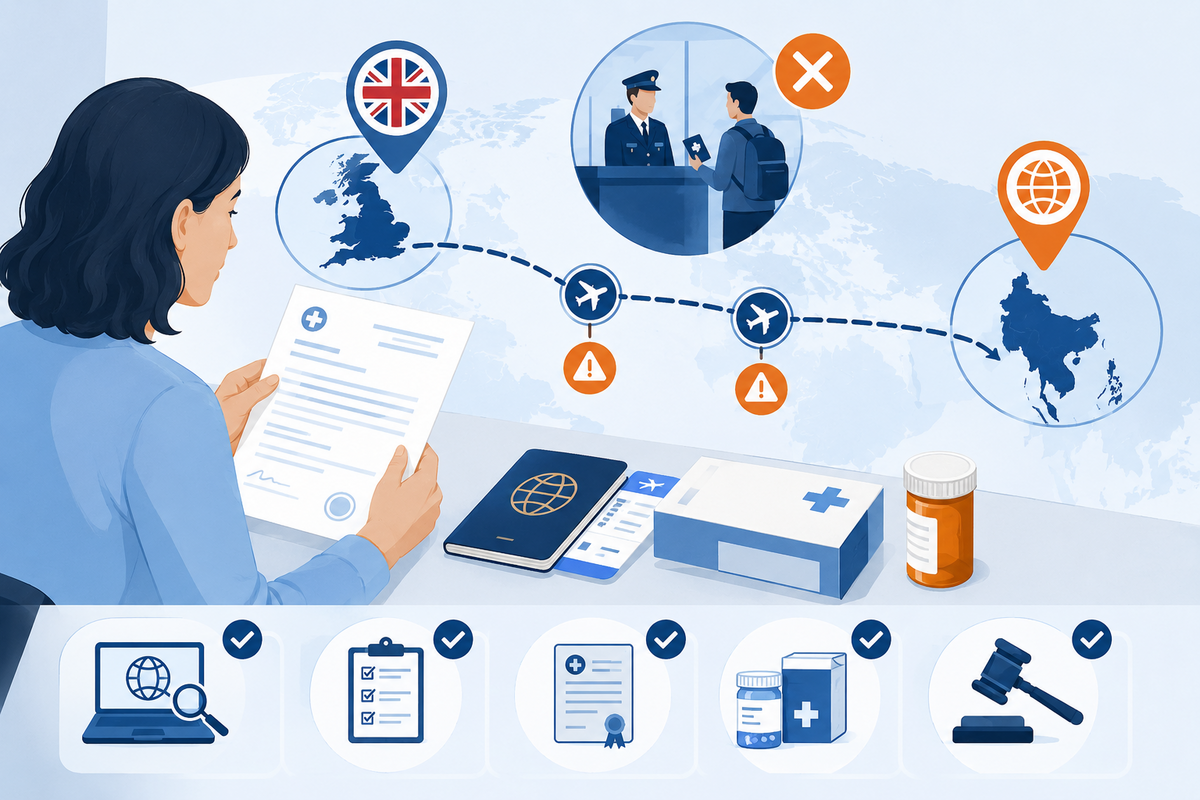
Medical cannabis is a controlled drug and every destination country sets its own import, possession and documentation rules. Transit countries may also have separate restrictions, even where the traveller does not leave the airport.
Before travelling, a patient should:
Government guidance says that travellers taking controlled medicines out of the UK should check the destination country’s rules before departure and be able to prove that the medicine was prescribed to them. (GOV.UK)
Controlled medicine should generally be carried in hand luggage when entering or leaving the UK. It may be removed at the border if the traveller cannot prove that it was prescribed for them.
Some countries prohibit cannabis medicines entirely. Others require an import permit, advance approval or specific documentation. A clinic letter alone cannot override the law of another country.
Patients should check the rules well before booking or travelling, particularly where the journey involves several borders.

A patient with a lawful prescription should not be treated as though the medicine was automatically illicit. However, a prescription does not create an unlimited right to carry, consume or administer cannabis in every place or circumstance.
For example, a prescription does not give a patient the right to:
The regulations continue to prohibit administering cannabis-based medicinal products by smoking. Prescribed cannabis flower is generally administered using a suitable medical vaporiser or Thermal Extraction Device (TED) when that is the route directed by the prescriber. (GOV.UK)
Patients are entitled to appropriate clinical care, confidentiality and information about the potential benefits and risks of treatment. They should be told how to take their medicine, what side effects to watch for and what to do if a problem occurs.
Where a patient’s underlying condition meets the legal definition of disability, they may also be protected from unlawful discrimination and may be entitled to reasonable adjustments in employment or when accessing services. This protection depends on the person’s circumstances and is not automatically created by holding a prescription. (GOV.UK)
Patients who believe they have been treated unfairly should keep copies of their prescription, dispensing labels, correspondence and any relevant policies. Depending on the circumstances, they may need to raise the issue with the organisation, healthcare regulator, employer, trade union, ACAS, legal adviser or another appropriate body.
Medical cannabis has been legally available on prescription in the UK since 2018, but public understanding has not kept pace with the law.
A prescription provides a lawful route to treatment. It does not remove the need to follow prescribing instructions, driving law, workplace safety requirements, travel restrictions and controlled-drug regulations.
Patients, employers, healthcare professionals, police officers, landlords and venue operators all benefit from clear policies that distinguish lawful prescribed treatment from illicit cannabis use.
The Cannabis Trades Association supports proportionate regulation, responsible prescribing, informed patient access and clearer public understanding across the UK medical cannabis sector.
This article provides general information and should not be treated as individual medical or legal advice.
Patients should discuss treatment and driving with their prescriber or pharmacist.
Questions about employment, discrimination, possession or travel may require independent legal advice based on the individual circumstances.


