Regulators Turn Up the Heat on ‘Debanking’
FTC warning signals a global shift in how financial institutions treat lawful but “high-risk” industries

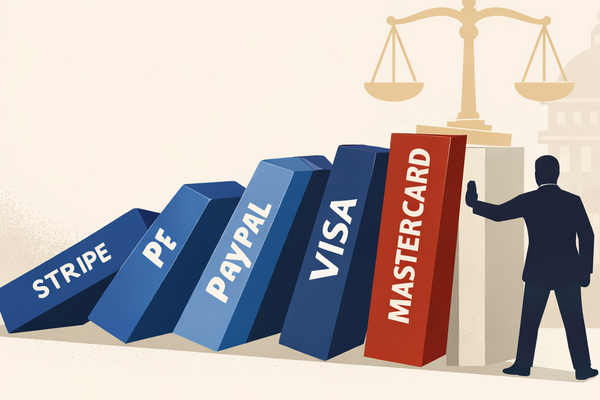
The Federal Trade Commission (FTC) has issued a clear and deliberate warning to some of the world’s largest payment providers. On 26 March, FTC Chairman Andrew Ferguson sent formal letters to Stripe, PayPal, Visa and Mastercard, outlining concerns over the denial of services to lawful businesses.
The message was direct. Refusing access to financial services on political, religious or ideological grounds could be considered an unfair practice under Section 5 of the FTC Act, opening the door to regulatory enforcement. This marks a notable escalation in how debanking is being viewed, no longer as a quiet commercial decision, but as a potential regulatory issue.
For years, financial institutions have relied on “risk appetite” to justify exiting or refusing entire sectors. Businesses operating in cannabis, CBD, supplements and other regulated categories have frequently found themselves excluded, often with little explanation and even less recourse.
The FTC’s intervention challenges that position. The concept of “high-risk” is no longer being accepted without scrutiny. Regulators are beginning to ask whether such classifications are genuinely evidence-based or simply convenient justifications for exclusion.
This reframes debanking as a matter of fair market access, not just internal policy.
The FTC’s action follows an August 2025 executive order issued by Donald Trump, which sought to prohibit what was described as “politicised or unlawful debanking”.
While executive orders do not automatically translate into enforcement, they set the tone. The FTC’s letters suggest that tone is now being acted upon, with regulators willing to revisit past decisions that were previously justified under reputational risk frameworks.
One of the most significant aspects of the FTC’s warning is its scope. Responsibility is not limited to individual payment processors. It extends across the wider payments ecosystem.
Card networks such as Visa and Mastercard were explicitly flagged as potentially accountable where their member banks or partners engage in debanking practices. This signals a move toward shared responsibility across financial infrastructure, rather than isolated decision-making. If enforced, this could require far greater oversight and justification throughout the entire payments chain.
The direction of travel is clear. Financial institutions will increasingly need to evidence their decisions.
Account closures and service refusals may need to be supported by documented, objective risk assessments. Internal policies and decision-making frameworks could come under scrutiny, particularly where entire sectors have been excluded without clear justification.
This introduces a new layer of regulatory exposure for firms that have historically taken a cautious or exclusionary approach.
Although the current developments are centred in the US, similar pressures are emerging in the UK and across Europe. The Financial Conduct Authority has already faced growing scrutiny over account closures affecting lawful but non-standard industries. Across the EU, regulators are grappling with how anti-money laundering frameworks and broader risk controls intersect with fair access to financial services.
A consistent theme is emerging. Blanket exclusions of legal sectors are becoming harder to justify. Proportionality, transparency and fairness are moving to the forefront of regulatory expectations.
For sectors such as cannabis, CBD and emerging health products, the implications are significant. These industries have long faced barriers to banking and payment services, limiting growth and creating unnecessary friction in otherwise compliant operations.
Marika Graham-Woods, Chair of the Cannabis Trades Association, said:
“Being labelled ‘high-risk’ has too often been used as a catch-all justification to deny lawful businesses access to essential financial services. Regulators are now rightly asking for evidence, consistency and accountability. This is a necessary shift toward fair and proportionate treatment.
For too long, ‘risk’ has been used as a convenient excuse to exclude entire sectors without justification. Lawful businesses should not be penalised for operating in regulated industries. If decisions cannot be evidenced, they should not be made.
The idea that ‘high-risk’ is enough to deny service is no longer sustainable. If a business is legal, compliant and transparent, it should not be arbitrarily excluded. This is about fair access to markets, not internal comfort levels.”
The FTC’s warning may prove to be an early indicator of a broader global shift. Financial institutions are no longer operating in isolation when it comes to client selection. The expectation is changing. Firms may soon need to justify not only who they choose to serve, but who they exclude and why.
For industries that have spent years navigating inconsistent access to financial services, this moment could mark the beginning of a more accountable and transparent system. Whether that potential is realised will depend on how far regulators are willing to go in enforcing it.


