420 and a Shift in Public Mood
Britain moves beyond cannabis criminalisation following YouGov poll



According to YouGov polling, 47% of British adults now support the legalisation of cannabis, compared to 43% who oppose it. While closely balanced, the figures mark a clear departure from the firm opposition that has historically underpinned UK drug policy.
More tellingly, when given a range of policy options, only 35% of respondents support maintaining cannabis as a criminal offence. A combined 56% favour either decriminalisation or full legalisation, indicating that the centre of gravity in public opinion has shifted.
Marika Graham-Woods, Executive Director at the Cannabis Trades Association, said:
“420 has often been treated as a cultural marker, but this data shows something far more serious. The public is no longer anchored to criminalisation as the default. That creates space for a more mature, evidence-led conversation about what proportionate policy actually looks like.”
The findings reflect a population that is increasingly informed by lived experience. Thirty-seven per cent of respondents report having used cannabis at some point, reinforcing its position as a mainstream issue rather than a marginal one.
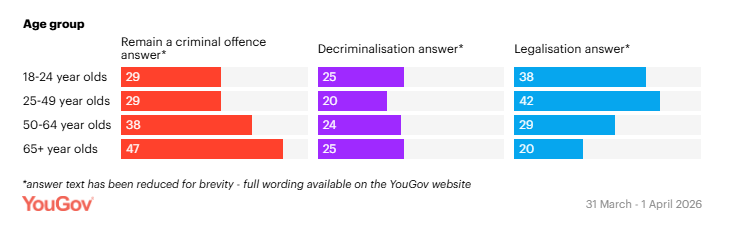
Generational differences remain pronounced. Among 18 to 24 year olds, support for legalisation stands at 57%, compared to just 34% among those aged 65 and over. This gap points to a long-term trajectory in which reform becomes more, not less, politically viable.
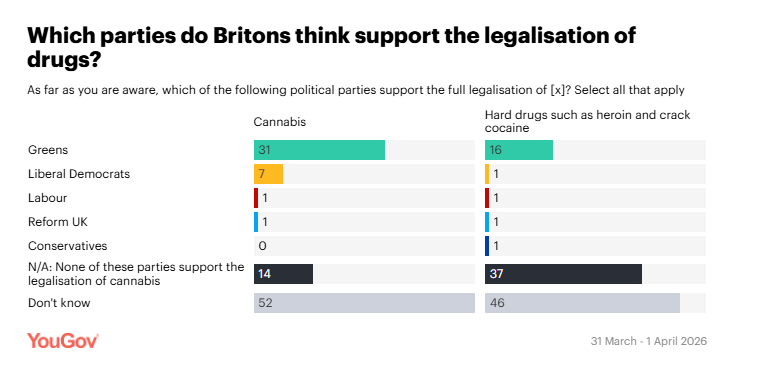
Political alignment continues to shape attitudes, but not in a uniform way. While support is strongest among Green and Liberal Democrat voters, no voter group is wholly opposed. Even among more traditionally conservative blocs, opinion is mixed, suggesting that cannabis reform is no longer confined to a single ideological lane.
Crucially, the public draws a clear distinction between cannabis and other controlled substances. Eighty-three per cent believe drugs such as heroin and crack cocaine should remain criminal offences, underscoring that attitudes towards cannabis are not simply part of a broader liberalisation of drug policy.
Marika Graham-Woods added:
“The public understands nuance. Cannabis is not being viewed through the same lens as harder substances, and policy needs to catch up with that reality. A one-size-fits-all approach is increasingly out of step with both evidence and public sentiment.
The survey also challenges the perceived effectiveness of prohibition. Only 29% of respondents believe making drugs illegal is effective in preventing use, while 60% consider it ineffective. That raises fundamental questions about the role and purpose of current enforcement strategies.
When asked how drug use should be approached, the public again takes a balanced view. Forty per cent say it should be treated as both a health and a criminal issue, with only a quarter favouring a purely criminal justice response.
David Case of the CTA’s Patient Voice Sector Strategy Committee said:
“As a member of the Welsh Liberal Democrats I would like to say the poll results broadly show our policies are well supported by the public. Yes to decriminalisation of cannabis, but not other drugs like heroin. The Liberal Democrats in general are very supportive of measures taken to protect patients, including medical cannabis patients and users of other drugs who need to administer in public spaces. I am thankful to the party for the support it has shown me and other medical cannabis patients in helping to tackle stigma and discrimination.”
Importantly, the data does not point to a surge in demand for widespread use. Among those who have never used cannabis, only 7% say they would be willing to try it if it were legalised. Even among previous users, a majority say they would not return to use. This challenges assumptions that reform would automatically drive significant increases in consumption.
The impact on crime remains an open question in the public mind. While 23% believe legalisation would lead to more crime, 29% think it would reduce it and 34% expect no difference. The absence of consensus here suggests that traditional arguments against reform are losing their clarity and influence.
For the Cannabis Trades Association, the message is clear:
Marika Graham-Woods concluded:
“The public is not calling for deregulation or disorder. It is calling for a system that is credible, proportionate and grounded in evidence. On a day like 4/20, it is worth recognising that the conversation has moved on. The question now is whether policy will move with it.”
Results from YouGov are below:


